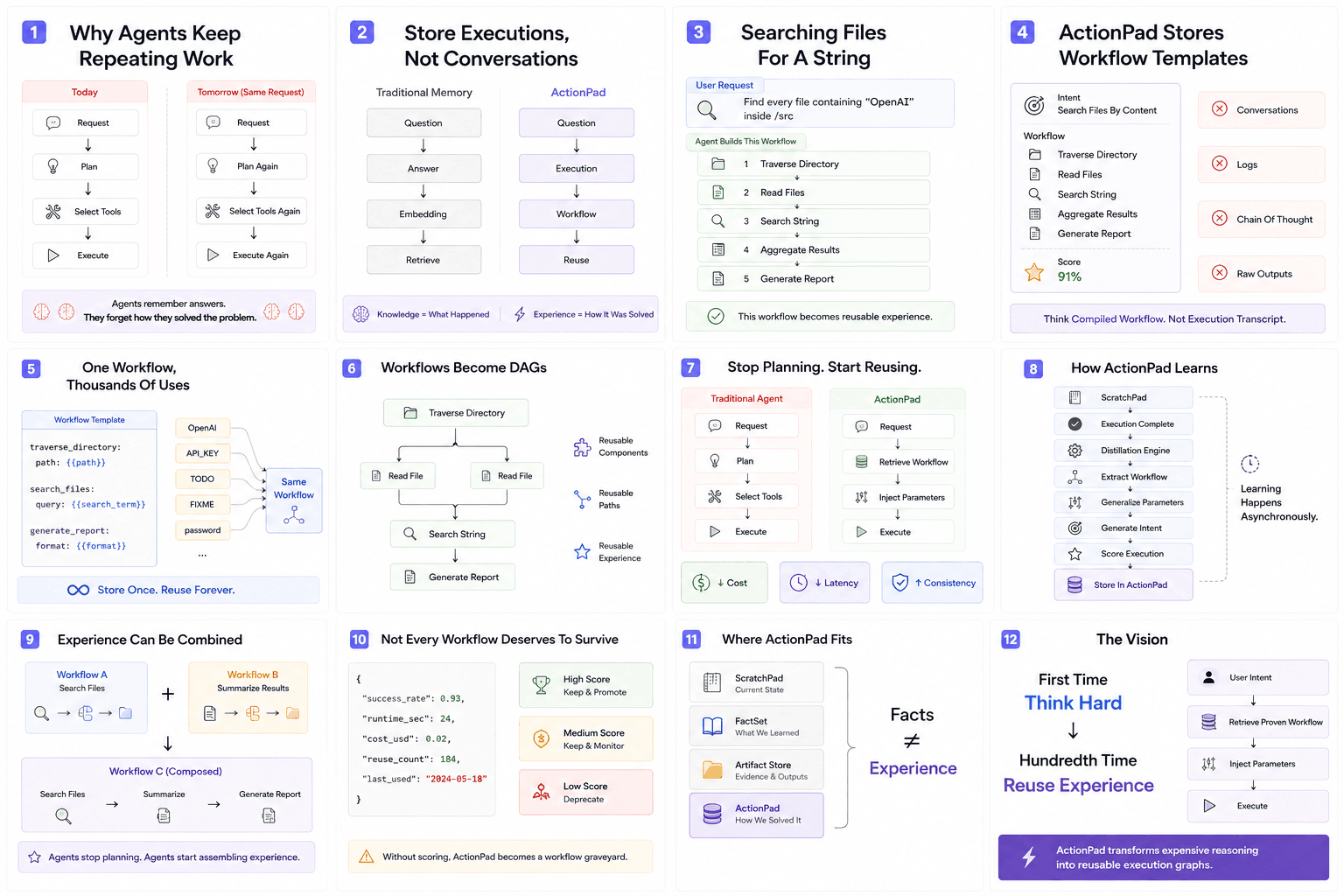
Most agents are surprisingly good at solving problems. The issue isn't intelligence, it's repetition.
Suppose a user asks:
Find every file containing "OpenAI" inside a repository.
The agent creates a plan, selects tools, executes the workflow, and produces a result. The next day the user asks:
Find every file containing "API_KEY".
The workflow is nearly identical, yet the agent rebuilds the entire execution plan from scratch. It remembers the answer, but it forgets the process.
As agents become more capable, repeatedly rebuilding known workflows starts becoming one of the biggest sources of wasted computation.
Store Executions, Not Conversations
Most memory systems store information. They remember documents, conversations, and outputs. That's useful, but information isn't the same thing as experience.
Experience is knowing how a problem was solved.
The key shift is simple:
Traditional memory stores what happened.
ActionPad stores how it happened.
Instead of indexing outputs, ActionPad captures the execution itself and treats successful workflows as reusable assets.
Turning Work Into Reusable Assets
Consider a simple file search task.
The agent eventually discovers a workflow for solving it:
Most systems throw this workflow away immediately after execution. Once the task is complete, all of the reasoning, planning, and tool selection that produced the result disappears.
ActionPad keeps it.
The workflow itself becomes an asset that can be reused later.
One Execution Can Power Thousands Of Requests
A workflow shouldn't be tied to a specific keyword. Instead, the inputs are generalized and the workflow becomes a reusable template.
The same workflow can now support thousands of future requests without requiring the agent to rediscover the solution each time.
Rather than paying the reasoning cost for every execution, the cost is paid once and reused repeatedly. As systems scale, that distinction becomes increasingly important.